
The Texas Branch

Updated: Aug 27
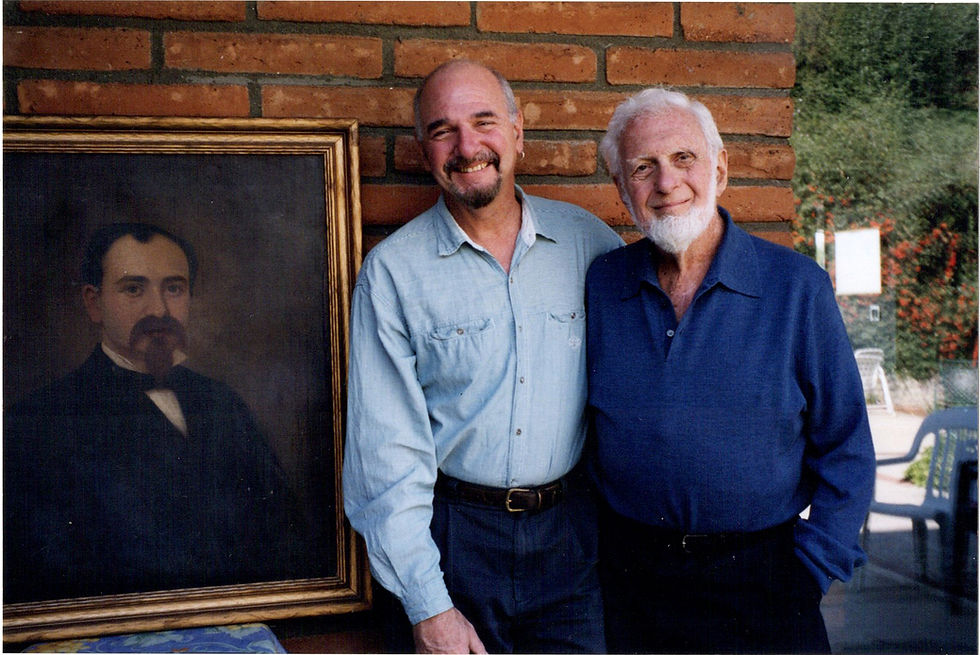
I vaguely knew that my paternal grandmother had grown up in Texas, although she married and spent her adult life in Chicago. She died when I was 2 years old, and since my father, seemingly uninterested in family history, never spoke of her nor contextualized the few aunts that flowed from the Texas branch, I gave it no thought. I really believed that our family history unfolded its unremarkable story in the Midwest – German Jews who had preceded the unwashed masses fleeing the pogroms and constricted horizons of Russia and Eastern Europe.
In 2003, I visited friends in San Antonio and took the opportunity to dig into the family history, not only in Alamo City but also in Victoria, Galveston, and Houston. Well… it turned out that I had lots of relatives in the Lone Star state, some of them of local renown, but growing up liberal in California meant Texas was not only a foreign land but inhabited by foreign people as well.
However, the dark oil painting hanging over the parlor fireplace that I never asked about was of my great-grandfather, Moses Haas, who immigrated to the U.S. from Prussia in 1866, married a Levi from Victoria, TX, and became a solid member of the San Antonio Jewish community. The language of his home was German, as was the case for 97% of settlers in the German belt encompassing Houston, the Hill Country, and San Antonio.
But it was the family of his wife, Rosa Levi, which provided the real distinction of the Texas branch. Rosa’s father, Abraham Levi, grew up in Alsace, France, and immigrated to the U.S. via New Orleans and up the Mississippi in 1846 at the age of 24. He followed the typical Jewish trajectory of starting a dry goods store that morphed into a bank (who else had safes and cash reserves on the frontier?). In Abraham’s case, A. Levi and Company became the largest state-chartered bank in Texas. And, taking on the coloration of the local population, the Levi company purchased 25,000 acres of land in six Texas counties and acquired extensive cattle interests.
Nonetheless, although the Texas branch attained moderate to rather impressive commercial success, its social world was strictly segregated. Both Moses in San Antonio and Abraham in Victoria helped establish synagogues. When the Levis married, they did so in Jewish temples and never married outside the faith. When they died, they were buried in Jewish cemeteries. (What makes this fact so striking for me – a gay Jewish man without wife or children, who never belonged to a synagogue and who spent most of his life without Jewish solidarity – was that this socially ghettoized existence was only two generations back.)
The patriarch, Abraham, produced a brood of children from his Texan wife, Mina Halfin (a ranching family and another story), including my great grandmother, Rosa Levi (1858 - 1952), and the most spectacular exponent of the Texas branch, Leo Napoleon Levi (1856 - 1904). Leo lived up to his grandiloquent name, the first Texas-born Jew to achieve national recognition.
Of course, he was brilliant and graduated from Victoria High School at age 15. His father sent him to New York to take a commercial course because that was "the Path of Jewish success", but Leo hated it, dropped out, and enrolled the following year, 1872, to study law at the University of Virginia. This was at the beginning of the so-called Southern “Redemption,” a movement which successfully dismantled Reconstruction, restored white supremacy, and eliminated Republican political power. It wasn’t a great time to be a minority in the South.
Leo was the butt of severe antisemitism, but pluck, determination, and a gift for eloquence pulled him through. He won the university’s debater's medal, the essayist's medal, and ultimately the respect of his fellow students. (One of his classmates, Thomas Nelson Page, a tragically successful proponent of “plantation literature” mourning the loss of happy "darkies" and the white nobility of the antebellum South, depicted Leo N. Levi as a noble Jew overcoming adversity in the 1903 novel Gordon Keith.) Anyway, Leo finished his studies, returned to Texas at twenty, and got admitted to the bar despite being underage.
Leo continued his life of distinction and accomplishment, mostly as a lawyer in Galveston. He married a Jewish woman, produced six surviving children, moved to New York, was elected President of the B’nai B’rith in 1900, and died of a jaundice attack in 1904. He is buried in a Jewish cemetery in Brooklyn. His last public act was a petition he drew up and sent to the Russian government protesting the Kishinev pogrom of 1903.
I haven’t looked into the politics of the Texas branch, but I’d be surprised if they were anything but conservative to right-wing. They would have only been out of step with their neighbors on the issue of antisemitism, and I really doubt they gave much thought to the black and brown people in their environment. No Rosenwalds or Spingarns in the Texas branch.
One other anecdote surfaced in 1966. My father accepted the invitation to attend the wedding of the daughter of a Houston cousin, L. Miller, whose boastful materialism and Texan arrogance were not to my father's taste. The wedding reception was held at the one Jewish country club since the Houston elite wasn’t going to let kikes into their social spaces. And -- wouldn’t you know? -- The Willowisp Country Club also had an exclusionary policy: no people of color allowed. My father signed the guest book, MARTIN LUTHER KING.
— Robert Philipson
Read about the professorial foray that prompted this autobiographical essay in The Atlanta Compromises.
SHOGA FILMS is a non-profit production and education company. Please consider making a donation to help fund our efforts.


Comments